Nazi Racism and Antisemitism
Los pacientes del doctor GarcíaNazi Racism and Antisemitism operates in the novel as both an ideology and a practiced method: it classifies human beings as inferior, makes persecution appear justified, and gives perpetrators language with which to evade responsibility. Its most concentrated demonstration comes at Klooga, where Adrián Gallardo hears the order to kill Jewish prisoners and, despite recognizing their humanity, ultimately helps murder them. The scene traces how dehumanization can be learned, repeated, and turned into a defense against guilt.
Inherited Hatred and Racial Doctrine
Jan Schmitt’s antisemitism is rooted in a family history of loss that his father, Klaus, interprets as Jewish fault. After the German defeat, Klaus’s brother Johann loses his business to creditors, including two Jewish moneylenders, and kills himself. Rather than recognize the failed financial decisions that preceded the ruin, Johann and Klaus blame the Jews who acquired the business through unpaid debts. Klaus repeats that explanation to his children, linking Martin’s death in the First World War, Josef’s disability, and Johann’s suicide to an alleged Jewish enrichment. All three children learn the story; Jan alone inherits Klaus’s debts as well as his hatred. The novel thus shows prejudice not as an automatic consequence of hardship but as a story that assigns suffering to a scapegoat and is handed down as if it were an explanation.
At the front, Jan gives that inherited hatred a purportedly scientific form. When Adrián challenges the idea that Slavs can be inferior while Russian soldiers are defeating them, Jan compares them to lions that can kill human beings yet remain animals. He presents racial ranking as objective truth, not as a belief requiring evidence. The reasoning is circular: military strength does not disprove inferiority because the group has already been defined as outside humanity. Jan extends the same logic to Jews. On the journey through Ukraine and Estonia, he sees people marked with yellow stars, fenced ghettos, and the violence inflicted on their inhabitants, yet interprets their vulnerability not as evidence of persecution but as confirmation that they are lesser beings. His words make hatred sound like neutral classification and cruelty like a natural response to a supposedly self-evident distinction.
From Dehumanizing Speech to Organized Murder
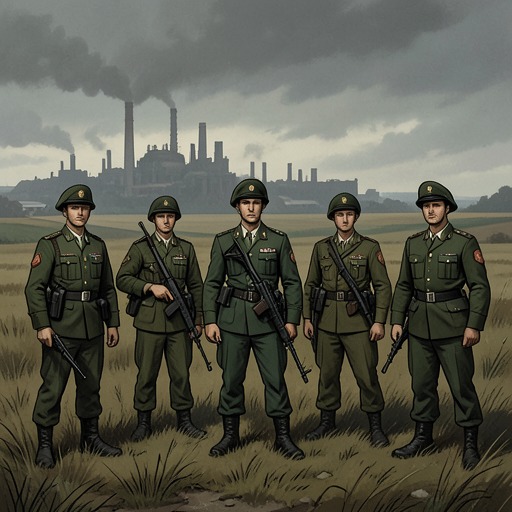
The doctrine becomes operational at Klooga. Captain Kleiber gathers soldiers beside a group of one hundred Jewish men and one hundred Jewish women and announces that they must be eliminated. His language avoids naming the prisoners as people, Jews, or even nonhumans. Instead, he gives a procedural plan: two firing squads of twenty-five, taking turns, with the work to be completed quickly so the soldiers can return to the barracks and repeat it in the afternoon. The euphemistic, administrative manner is part of the violence. A mass killing is presented as a task with a schedule, a staffing arrangement, and an end to the working day.
Adrián understands the order in German and watches the prisoners being separated, with the women selected to die first. Jan murmurs that they are not human, repeating the category that has made the murder imaginable. Adrián answers that they are human after all, but this recognition does not stop him. Earlier, Jan had described the deaths and disabilities in his family and the hatred Klaus had cultivated in him. Adrián had listened without taking the story seriously; now he realizes that the words remained in his memory even when they had not seemed to reach his conscience. His belated recognition connects the intimate inheritance of antisemitism to the command before him, without making him an innocent bystander.
The narrative sets Jan’s doctrine against his conduct in other parts of life. Adrián remembers him as generous, loyal, funny, willing to help a comrade, and capable of risking himself for the weak. Yet Jan can watch the humiliation of Jewish people without intervening, insisting that they are only bipedal mammals rather than human beings. The contrast matters: ordinary kindness does not dissolve ideological hatred. Jan’s public decency coexists with a racial belief that places its targets beyond the moral obligations he extends to others.
Complicity, Rationalization, and Guilt
The killing exposes the distance between Adrián’s awareness and his actions. He had not known that the volunteers were being taken to a concentration camp or what would happen there, but ignorance becomes harder to claim once Kleiber gives the order. The sight of Heinrich Beyer dying with his hand closed around the cord of his scapular sharpens the scene’s moral stakes: Beyer has refused to shoot and is killed, while Adrián remains among the soldiers who fire. The episode does not present refusal as costless, but it makes the difference between disobedience and participation unmistakable.
During the afternoon shootings, Adrián imagines refusing the order as Beyer did. He pictures standing still with his rifle, admitting that he has already killed too many innocents. When Kleiber commands the squad, however, Gallardo loads, aims, and fires at successive groups of women. The private fantasy of resistance gives way to repeated action. His decision is consequential not because he lacks all recognition of what is happening, but because recognition and imagined compassion fail to become refusal.
As he fires, Adrián constructs a rationale that reverses the direction of blame. He decides that the Jewish prisoners are the fiercest enemies he has ever fought and that their passivity is making him a murderer. He even interprets their apparent submission to martyrdom as a deliberate accusation against their executioners. In this distorted account, the victims’ innocence becomes the means by which they supposedly condemn him; he then treats that imagined condemnation as proof that they are responsible for his violence. The reversal converts perpetrator guilt into hatred of the people being killed.
The result is more than an excuse offered after the fact. Adrián’s new explanation brings him a savage relief and pleasure, allowing him to accept a murderous identity by assigning its cause to the victims. He recognizes that the prisoners are human and not inferior, yet simultaneously tells himself that they want to die. The contradiction is central to the novel’s treatment of antisemitism: knowing that a racist claim is false does not necessarily free someone from complicity when the claim can be reshaped into a defense against responsibility.
Historical Continuities and the Limits of Accountability
The concept extends beyond Klooga through the novel’s attention to postwar institutions and political language. The Allied list of 104 fugitives identifies Clarita Stauffer as a key organizer of a secret aid association involved in forged documents and employment for Germans, and notes that she received Spanish nationality after the war to continue activities following Germany’s defeat. Yet the Spanish authorities refuse to surrender her, presenting her as a Madrid-born patriot and associate of Pilar Primo de Rivera. The episode shows how political protection and official descriptions can shield people implicated in Nazi networks even after the regime that sustained them has fallen.
The empty German Embassy in Madrid offers a related image of disappearance and concealment. When Allied representatives finally enter on 5 June 1945, almost a month after Berlin’s capitulation, the building has been stripped of records, money, gold, antiques, art, and furniture. Hans Lazar, found there in a silk dressing gown, identifies the building as his private residence and claims to be doing nothing particular. The scene does not itself establish that every missing item or document was connected to racial persecution, but it places the erasure of Nazi institutional traces alongside the postwar effort to pursue fugitives and recover evidence.
Hans Aumeier’s case makes the gap between crimes and accountability explicit. After his arrest in June 1945, he is extradited to Poland and tried for his actions at Auschwitz. He pleads not guilty, denies the existence of gas chambers, and describes himself as a scapegoat for Germany’s defeat. Sentenced to death, he is hanged in Kraków in 1948. His Auschwitz crimes prevent him from being tried for the Klooga massacre. A monolith at the former camp commemorates more than two thousand people murdered there. The memorial names the victims’ innocence, while the history of Aumeier’s prosecution also records how one set of crimes could displace the legal reckoning with another.
The novel finally places the racial language of Nazi violence in a wider field of political justifications. In discussion of the postwar order, Manuel Arroyo describes how the account of the defeat of Hitler shifts toward the Normandy landings and away from the Eastern Front, while Franco presents himself as an anticommunist ally. He also notes rumors that Allied commanders are recruiting Nazis for antisoviet work. Later, the account of the 1976 Argentine dictatorship identifies the National Security Doctrine as a Cold War policy that supports military rule in the name of defeating communism, with repression extending to dissidents as well as armed opponents. These are not the same ideology as antisemitism, but their juxtaposition shows a recurring political operation: defining a group as an existential threat can make exceptional violence appear necessary, while changing alliances can leave earlier perpetrators useful and protected. From Jan’s inherited explanation of family ruin to Kleiber’s bloodless plan and Adrián’s victim-blaming, the novel follows the conversion of prejudice into action—and the further conversion of action into self-exculpation.